Bronx Post Newsroom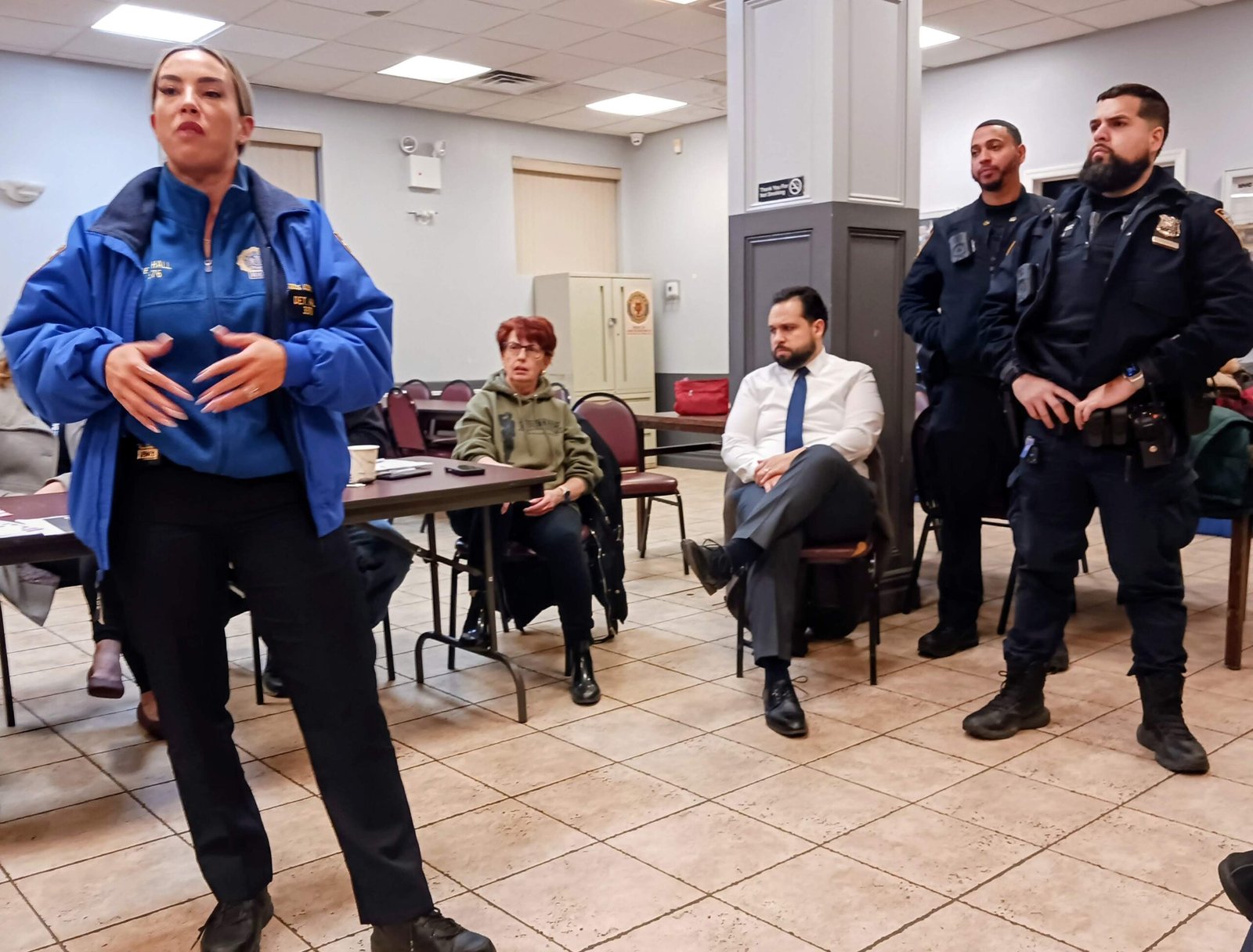
By Robert Press
The Morris Park Community Association (MPCA) convened a well-attended February meeting that brought together a cross-section of city and state officials, law enforcement representatives, and infrastructure leaders to address pressing concerns facing the Bronx community.
The evening opened with remarks from members of the NYPD’s 49th Precinct. Community Affairs Detective Hall introduced two officers from the precinct’s Quality of Life (Q-Team) unit, Officers Fernandez and Gil, who explained their role in responding to 311 complaints and addressing quality-of-life issues across the neighborhood. The officers fielded questions from residents before returning to patrol duties, underscoring the precinct’s emphasis on community engagement.
Assemblyman John Zaccaro, who arrived directly from Albany, provided an update on legislative developments. He announced his recent appointment to the Assembly Housing Committee and highlighted upcoming community initiatives, including a free tax assistance and food distribution event. Responding to questions about Mayor Zohran Mamdani’s recent funding requests in Albany, Zaccaro noted that he does not serve on the committee before which the mayor appeared. A representative from Congressman Ritchie Torres’ office also addressed inquiries, explaining that the U.S. Postal Service does not directly coordinate with the congressman’s office on operational matters.
Infrastructure and environmental resilience took center stage during a presentation by Bronx Department of Environmental Protection (DEP) Commissioner Effie Ardizzone. She focused on the growing strain on the city’s sewer system caused by increasingly intense storms and ongoing development. Ardizzone explained that downspouts traditionally channel roof runoff into the sewer system, contributing to overload during heavy rainfall. DEP is encouraging property owners to redirect runoff into yards instead, and in past years has distributed rain barrels to help manage excess water for reuse in gardening and other non-potable purposes.

 iArdizzone also offered winter preparedness guidance, advising residents to run faucets during extreme cold to prevent pipes from freezing. If freezing occurs, she cautioned against using open flames to thaw pipes, recommending instead the use of hair dryers or heaters to avoid the risk of explosions. Residents were directed to follow “NYC Water” on social media for additional updates and safety tips.
The final presentation of the evening came from Jose Rodriguez of Propel NY Energy, who outlined plans for a large-scale underground electric transmission project designed to address rising regional energy demand. Rodriguez clarified that Propel NY is not a battery storage system, offshore wind installation, or new energy generation source. Instead, he described it as core infrastructure intended to redistribute existing electricity more efficiently across the metropolitan region, including Long Island.
According to Rodriguez, much of New York’s transmission infrastructure dates back to before 1980, and demand is projected to increase by 50 to 90 percent over the next two decades. He cited growing reliance on electrical devices and the rapid adoption of electric vehicles—particularly on Long Island—as key drivers of the anticipated surge. While Propel NY will not produce additional power, he said, it will modernize and reinforce the transmission network to ensure reliable distribution where it is most needed. The project is being permitted under New York State’s Article VII process.
The meeting concluded with residents continuing informal discussions with officials, reflecting the MPCA’s role as a forum for civic dialogue on issues ranging from public safety to environmental resilience and long-term energy planning.