Bronx Post Newsroom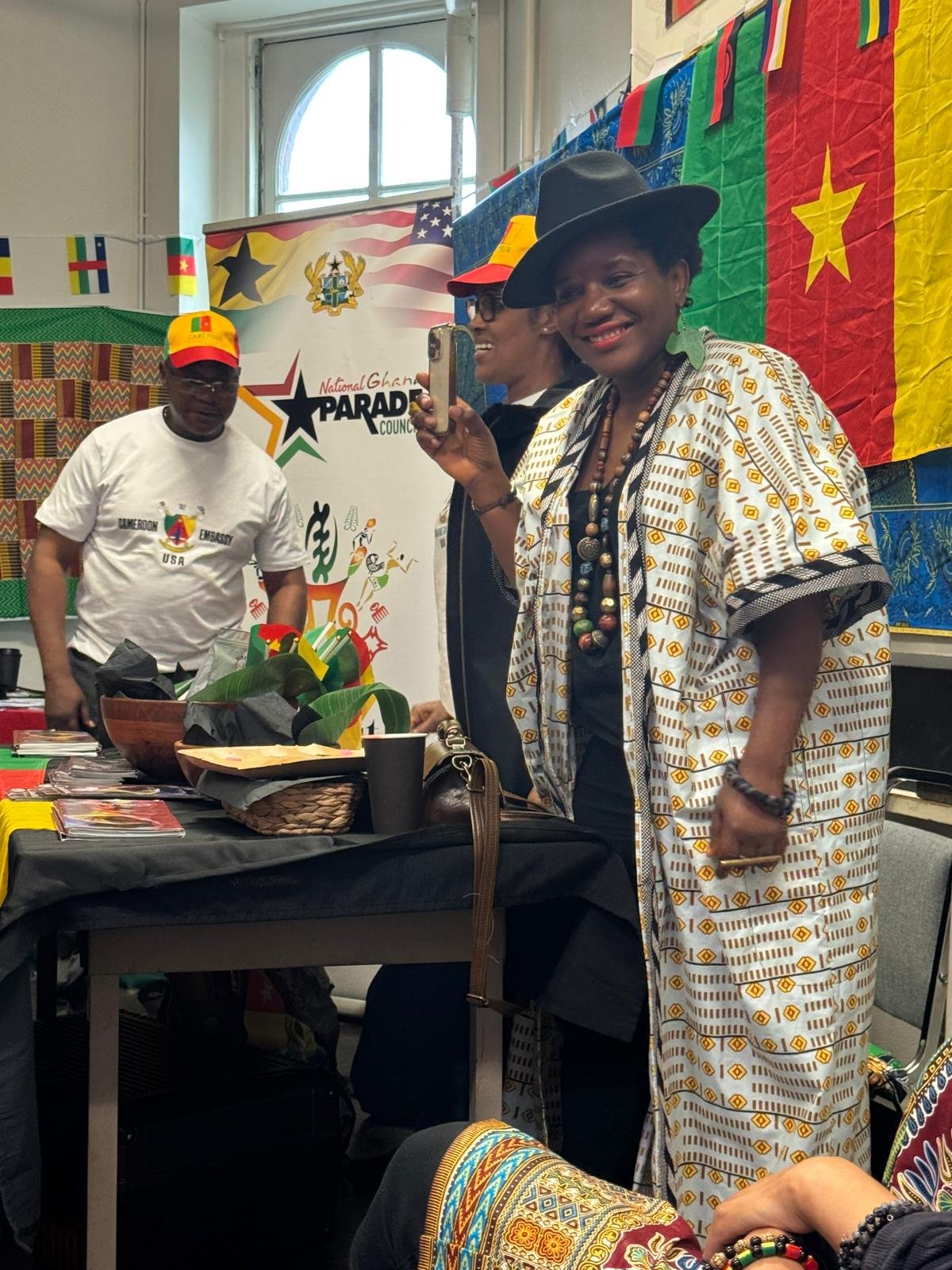
By Mutiu Olawuyi
Cameroon emerged as a powerful symbol of African cultural responsibility at the Museum of Africa inaugural public exhibition, organized by Daylight Africa during the Africa Day celebration at Bronx Community College.
The Cameroonian delegation was led by Samuel Makebeh, Cultural Attaché and Education Officer at the Embassy of Cameroon in the United States of America, based in Washington, D.C. His presence gave the event formal diplomatic weight and positioned Cameroon as the first and only African country to officially exhibit its national heritage at the Museum of Africa’s public opening exhibition.
The distinction was significant because, according to organizers, all African countries were invited through their embassies in Washington, D.C. Cameroon, however, stood alone as the only nation that answered the call with visible representation and a cultural display.
For an event created to preserve African memory, celebrate continental identity, and reconnect Africa with its diaspora in the Bronx, Cameroon’s participation carried a message larger than one country’s exhibition table. It showed that cultural diplomacy is not only about official speeches, national days, or embassy receptions. It is also about showing up where African descendants, immigrants, students, artists, educators, and community leaders are building spaces to protect and project African heritage.

Speaking at the event, Samuel Makebeh represented Cameroon with pride, joining community leaders, cultural advocates, and African heritage organizers in affirming the importance of passing African history and identity to the next generation.
His presence reflected the role of cultural attachés as bridge-builders between governments and communities. In diaspora spaces such as the Bronx, that role becomes even more important. A cultural attaché does not only represent a flag; he represents a people, a history, a language, a national image, and a living bridge between the homeland and its global family.

Sheikh Musa Drammeh, co-founder and Chairman of Daylight Africa and principal organizer of the Museum of Africa exhibition, praised Cameroon’s representation and said the embassy’s presence would be remembered as part of the museum’s early history.
“We deeply appreciate and acknowledge the Embassy of Cameroon, led here by Cultural Attaché Samuel Makebeh, for standing with us at this historic inaugural exhibition,” Drammeh said. “Cameroon did not only represent itself; it represented the dignity of Africa, the seriousness of cultural diplomacy, and the responsibility every African nation has toward its people in the diaspora.”
Drammeh added that the event was designed as a continental platform, not a single-community celebration.
“We invited African countries through their embassies because the Museum of Africa belongs to all of Africa and all people of African descent,” he said. “Cameroon’s presence sends a strong message that African nations must not leave their stories to be told by others. They must show up, bring their heritage, and help educate the next generation.”
The Museum of Africa exhibition featured African historical displays, visual art, cultural materials, flags, and educational narratives aimed at helping the public understand Africa’s global contributions. The event also created a space for intergenerational learning, where young people could encounter African history not as distant memory, but as a living source of pride and identity.
Cameroon’s participation was therefore more than ceremonial. It helped establish a standard for future exhibitions and for how African embassies can engage diaspora communities in New York.
The country’s cultural presence projected an image of seriousness, pride, and diplomatic awareness. In a global environment where African countries continue to battle outdated stereotypes, cultural visibility matters. Every embassy has a responsibility to help correct misrepresentation by presenting the beauty, complexity, creativity, and resilience of its people.
Cameroon accepted that responsibility at Bronx Community College.
The absence of other invited African embassies should also be noted with respect but clarity. The Museum of Africa exhibition was not an ordinary local gathering. It was a historic public cultural platform in the Bronx, one of America’s most diverse counties and home to a large population of African immigrants and descendants.
When embassies miss such opportunities, they miss the chance to support their diaspora, promote tourism, educate the public, strengthen cultural diplomacy, and inspire young people who are searching for stronger connections to the continent.
Cameroon’s example offers a practical lesson: cultural diplomacy does not always require a massive budget. Sometimes, it begins with representation, humility, national pride, and the willingness to stand beside community institutions doing the work of memory preservation.
For Daylight Africa and African Union Day Foundation, the Embassy of Cameroon’s participation was a major encouragement. For the Museum of Africa, it was a foundational endorsement. For the Bronx community, it was a reminder that Africa’s story must be told by Africans, in partnership with the diaspora, and with the active support of African governments.
As the Museum of Africa continues to grow, Cameroon has already secured a special place in its beginning. It was the first and only African country to formally exhibit its cultural heritage at the inaugural public exhibition.
That presence was not just attendance. It was leadership.